
Imagine a bird so talented it was used to deliver critical messages across enemy lines during both World Wars, saving thousands of human lives. Now, imagine that same bird bobbing its head on a park bench, waiting for you to drop a piece of popcorn.
It sounds like a contradiction, but it isn’t. It is the story of the Rock Pigeon.
While many urbanites dismiss them as “rats with wings,” the Rock Pigeon (and its city-dwelling descendants) is a biological marvel with a history deeply intertwined with human civilization. From the cliffs of Europe to the skyscrapers of New York City, these birds are the ultimate survivors.
Whether you are a birdwatcher trying to identify a wild specimen, a homeowner looking to manage them humanely, or just curious about the birds in your backyard, this guide covers everything you need to know.
- Introduction: More Than Just a "City Bird"
- Unraveling the Identity: What is a Rock Pigeon?
- Life in the Wild and Urban Jungle: Habitat and Distribution
- Daily Life of a Rock Pigeon: Diet and Foraging
- Reproduction and Life Cycle: Raising Squabs
- Behavior and Social Dynamics
- Rock Pigeons and Humans: A Shared History
- Fascinating Facts and Myths
- Conclusion: Appreciating the Adaptable Rock Pigeon
- Frequently Asked Questions (FAQs)
Introduction: More Than Just a “City Bird”
Most of us see pigeons every day, yet we know very little about them. Did you know that the common city pigeon is actually a domesticated animal that went feral, much like a stray cat?
The story of the Rock Pigeon begins thousands of years ago. Humans domesticated them for food, fun, and communication. In fact, they were the world’s first high-speed internet, carrying messages across empires long before the telegraph existed.
However, somewhere along the line, they escaped. Today, we have a mix of true wild Rock Doves and their feral cousins, the Common Pigeon. This article will help you spot the difference, understand their fascinating biology, and learn how to coexist with them.
Unraveling the Identity: What is a Rock Pigeon?
To understand this bird, we first need to look at its name and classification.
Scientific Classification and Nomenclature
The official scientific name for the Rock Pigeon is Columba livia. It belongs to the family Columbidae, which encompasses both pigeons and doves. Is there a scientific difference between a “pigeon” and a “dove”? Not really. They are part of the same family, though “dove” is often used for smaller species and “pigeon” for larger ones.
You will often hear them referred to by several names:
- Rock Dove (referring to the wild ancestor).
- Feral Pigeon (referring to the urban population).
- Common Pigeon.
Physical Characteristics: A Closer Look
Identifying a pure wild Rock Pigeon requires a keen eye. Here is what you should look for:
- Size and Shape: They are tubby, distinct birds, usually 11–14 inches long with a wingspan of 20–26 inches. They typically weigh between 9 and 13 ounces.
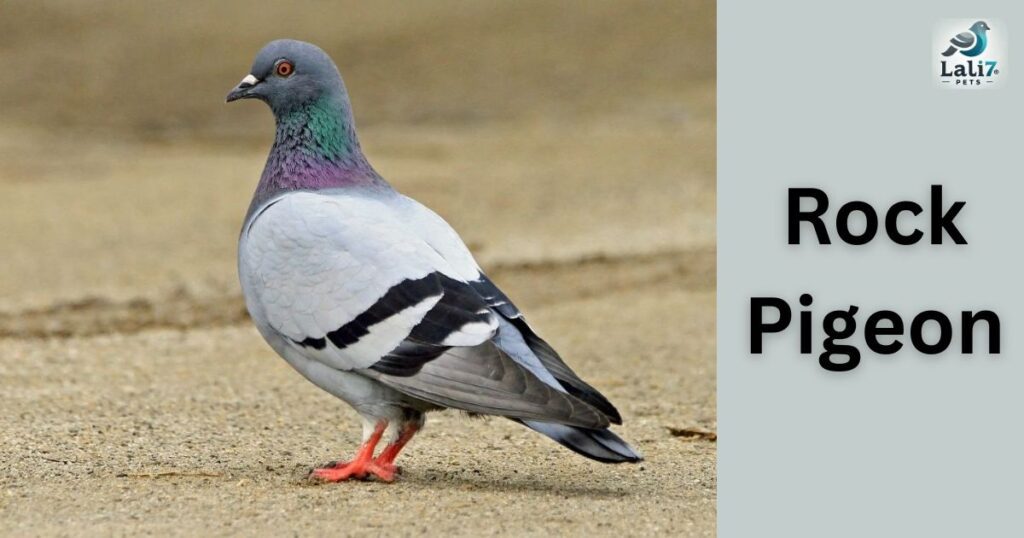
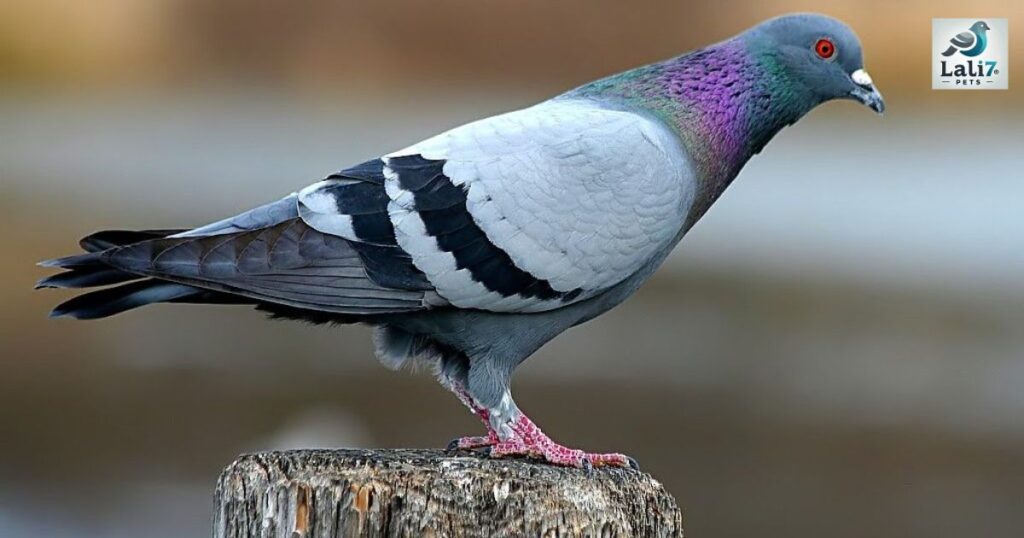
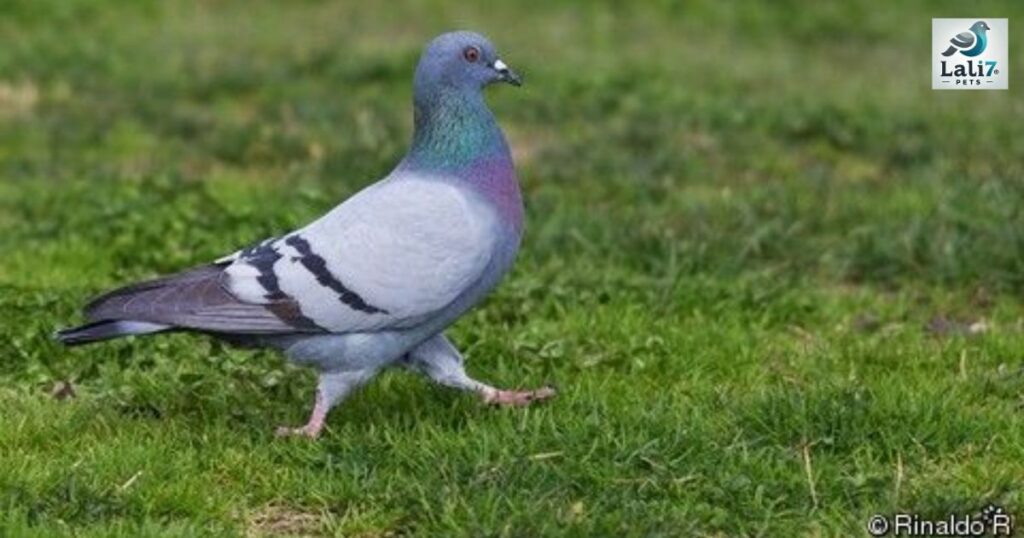
- Plumage: The “wild type” plumage is a bluish-gray. They have a dark head and an iridescent neck that shines purple and green in the sunlight.
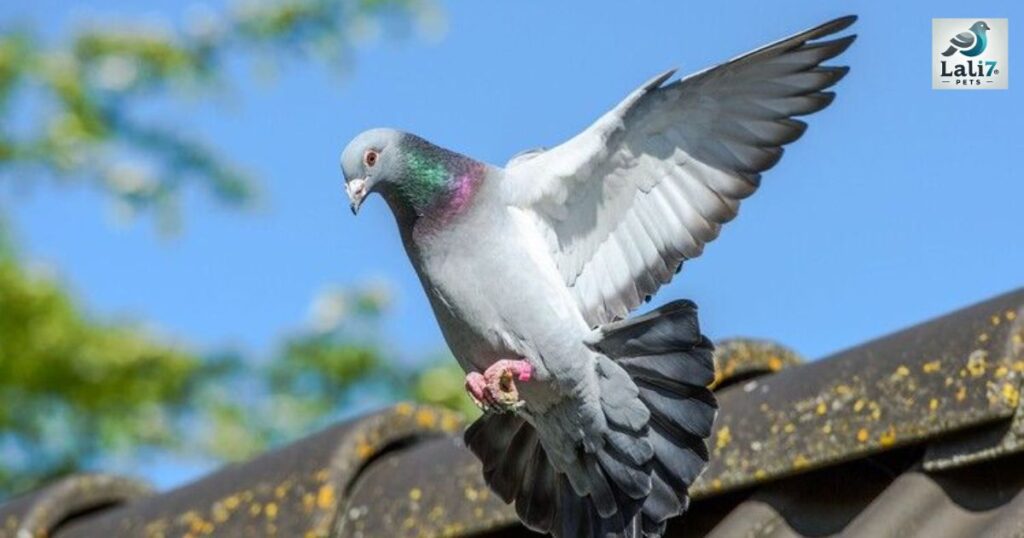
- Key Identification Marks: Look for two distinct black wing bars on the secondary feathers. In flight, you will see a white rump patch (just above the tail) and a dark band at the tip of the tail.
- Eyes and Feet: Adults generally have orange or red eyes and reddish-pink feet.
Rock Pigeon vs. Feral Pigeon: Understanding the Distinction
This is where many people get confused.
- Wild Rock Pigeon (Rock Dove): These inhabit natural cliffs and coastal environments. They almost always possess the standard blue-gray plumage described above.
- Feral Pigeon: These are the descendants of escaped domestic birds. Because their ancestors were bred for different colors (fancy breeds), feral flocks display a massive variety of colors. You will see checkered patterns, reddish-browns, pure whites, and spotted birds.
Key Takeaway: If you see a flock with mismatched colors in a city park, you are looking at Feral Pigeons. If you see a uniform flock of blue-gray birds on a sea cliff, you are likely looking at wild Rock Doves.
Comparing with Similar Species
It is easy to mix up the Rock Pigeon with other doves.
- Rock Pigeon vs. Mourning Dove: The Mourning Dove is slimmer, tan/brown, and has a long, pointed tail. The Rock Pigeon is chunky, gray, and has a short, square fan tail.
- Rock Pigeon vs. Eurasian Collared-Dove: The Eurasian Collared-Dove is a pale, sandy gray with a distinctive black half-collar on the back of its neck. It lacks the iridescent neck feathers of the Rock Pigeon.
Life in the Wild and Urban Jungle: Habitat and Distribution
Why are pigeons so good at living in cities? The answer lies in their evolutionary history.
Native Range and Original Habitat
The Rock Pigeon originated in Southern Europe, North Africa, and Western Asia. As their name suggests, their natural habitat is rock. They nest on high, sheltered cliff ledges and in sea caves, safe from most ground predators.
Global Spread
Following the Columbian Exchange, Europeans brought these birds to North America in the early 1600s. They were introduced as a food source but quickly escaped. Today, they are found on every continent except Antarctica.
Why They Love Skyscrapers
This is a perfect example of adaptation. To a Rock Pigeon, a concrete building with window sills, bridge supports, and AC units looks exactly like a natural cliff face.
- Urban Landscapes: They thrive on buildings and bridges.
- Rural Environments: You will find them in barns and grain towers (which mimic caves).
Because they are adapted to barren cliffs, they don’t need trees. This gives them a massive advantage over other birds in concrete jungles.
Daily Life of a Rock Pigeon: Diet and Foraging
What fuels these high-energy fliers?
Natural Diet
In the wild, Rock Pigeons are strictly granivorous (seed-eaters). They forage on the ground for seeds, wild grains, and occasionally small fruits. They rarely eat insects unless they consume them by accident.
Urban Diet Adaptations
City pigeons are the ultimate opportunists. While they still prefer seeds, they have adapted to survive on human refuse. Bread crumbs, popcorn, discarded fries, and dropped trailing mix are staples.
They use a “Producer-Scrounger” dynamic in their flocks. Some birds (“producers”) find the food, and others (“scroungers”) rush in to eat it. This social foraging helps the whole flock survive.
Unique Drinking Behavior
Here is a fascinating physiological trait: Most birds have to fill their beak with water and then tilt their head back to let gravity pull it down. The Rock Pigeon, however, can submerge its beak and suck up water continuously like a straw. This allows them to drink much faster and flee from predators more quickly.
Reproduction and Life Cycle: Raising Squabs
Rock Pigeons are prolific breeders, which contributes to their massive population numbers.
Mating and Courtship
Pigeons are generally monogamous and pair for life. If you have ever seen a male pigeon puff out his chest, fan his tail, and spin in circles while cooing, you have witnessed their courtship dance.
Nesting Habits
The nest is usually a flimsy platform of twigs and debris, often reused until it becomes a solid mound of droppings (which acts as cement). They build these on sheltered ledges—or your window sill.
The Squab’s Journey
- Eggs: The female typically lays 2 white eggs.
- Incubation: Both parents share duties for 16–19 days.
- Squabs: Baby pigeons are called squabs. They are born altricial (blind and helpless) with sparse yellow down.
The Miracle of “Crop Milk”
This is one of the most unique features of the Columbidae family. Pigeons produce a substance called crop milk.
Unlike mammalian milk, crop milk is a semi-solid substance similar to cottage cheese, sloughed off from the lining of the parent’s crop (a food storage pouch in the throat). It is incredibly high in protein and fat.
Both the male and female produce this milk. For the first few days, the squabs are fed exclusively on this “superfood,” allowing them to double in size rapidly.
Lifespan
Life is tough for a bird.
- Wild/Feral: The average lifespan is only 3–5 years due to predators and disease.
- Captivity: Protected from dangers, they can live 15 years, with some record-breakers reaching over 30!
Behavior and Social Dynamics
Flight and Movement
Rock Pigeons are built for speed. They have massive breast muscles and can fly at sustained speeds of 15–35 mph. Racing pigeons (specialized breeds) can clock in at over 90 mph! When they take off, you will often hear a loud clapping sound—this is their wings striking together to signal alarm to the rest of the flock.
Homing Ability and Navigation
How does a homing pigeon find its way back from 500 miles away? Scientists believe they use a combination of complex tools:
- Magnetoreception: They have iron-containing structures in their beaks that act like a compass to sense Earth’s magnetic fields.
- Sun Compass: They navigate using the position of the sun.
- Olfactory Cues: Recent studies suggest they may even create “smell maps” of their territory.
Rock Pigeons and Humans: A Shared History

Domestication and Historical Significance
We have lived alongside these birds for over 5,000 years. They were worshipped in ancient Mesopotamia and used by Romans to send chariot race results.
Perhaps most famously, Charles Darwin was a pigeon fancier. His observation of the vast differences between pigeon breeds (like Fantails and Pouters) helped him formulate his theory of natural selection. He realized that if humans could select for traits in a few generations, nature could do it over millions of years.
The “Pest” Perception
Despite their heroics in history, today’s urban Rock Pigeon is often viewed as a nuisance.
- Droppings: Their feces are highly acidic and can damage limestone and concrete on buildings.
- Disease: While concerns are often exaggerated, pigeon droppings can harbor fungi like Histoplasma. However, catching a disease from a casual encounter with a pigeon is extremely rare for healthy people.
Coexistence and Humane Management
If pigeons are causing issues on your property, poisoning is cruel and often illegal. Instead, focus on exclusion.
Step-by-Step Humane Deterrents:
- Remove Food Sources: Stop feeding them intentionally and secure trash cans. Pigeons will not stay where there is no food.
- Exclusion: Install bird netting or wire mesh over alcoves and vents to prevent nesting.
- Physical Deterrents: Use “bird spikes” or slope modifiers on ledges. These do not hurt the bird; they just make it impossible for them to land comfortably.
- Reflective Objects: Visual scares like reflective tape can work temporarily, but pigeons are smart and will eventually realize it’s a trick.
Fascinating Facts and Myths
- Myth: Pigeons are dirty and full of disease.
- Fact: Pigeons are surprisingly clean birds that bathe regularly. While they can carry pathogens (like any animal), the risk to humans is low compared to other pests.
- Fact: Pigeons can recognize human faces. If you chase them away, they will remember you. If you feed them, they will remember you even better!
- Fact: The Rock Pigeon is one of the few animals that can pass the “mirror test,” meaning they can recognize their own reflection.
Conclusion: Appreciating the Adaptable Rock Pigeon
The Rock Pigeon is more than just a statue-perching scavenger. It is a biological powerhouse, a war hero, and a scientific muse. They are the only wild animals that many city dwellers interact with daily.
While their droppings can be annoying, their presence is a testament to nature’s ability to adapt to the human world. Next time you see a pigeon strutting down the sidewalk, take a moment to admire the iridescent feathers on its neck and remember: you are looking at one of history’s greatest survivors.
Frequently Asked Questions (FAQs)
What is the primary difference between a Rock Pigeon and a Feral Pigeon?
Genetically, they are the same species (Columba livia). A Rock Pigeon usually refers to the wild, ancestral populations found on cliffs, which are almost always blue-gray. Feral Pigeons are the descendants of escaped domestic birds living in cities, displaying a wide variety of colors and patterns.
What do Rock Pigeons typically eat in both wild and urban environments?
In the wild, they are granivorous, eating mostly seeds and grains. In urban environments, they are opportunistic scavengers, eating bread, popcorn, food scraps, and spilled grain, though they still prefer seeds when available.
Where do Rock Pigeons prefer to build their nests?
They prefer flat, sheltered surfaces. In nature, this means cliff ledges and sea caves. In cities, they utilize window sills, bridge beams, building eaves, and air conditioning units.
How long do Rock Pigeons live on average?
In the wild or urban streets, life is harsh, and they typically live 3–5 years. However, in captivity with safe housing and veterinary care, they can live 15 years or more.
How do baby pigeons (squabs) get fed, and what is ‘crop milk’?
Squabs are fed crop milk, a semi-solid, protein-rich secretion produced in the throat (crop) of both parents. It is not dairy milk but is functionally similar in providing immune-boosting nutrition to the young.
Are Rock Pigeons considered an invasive species?
In North America and many other parts of the world, yes. They are an introduced, non-native species. However, because they have been established for centuries, they are often treated as naturalized citizens of the urban ecosystem.
What are some common predators of Rock Pigeons?
In cities, their main predator is the Peregrine Falcon, which also nests on tall buildings. Other predators include hawks, owls, raccoons, and domestic cats.
Can Rock Pigeons carry diseases that are harmful to humans?
Yes, their droppings can harbor the fungus Histoplasma capsulatum (causing histoplasmosis) and bacteria like Salmonella. However, direct transmission to humans is rare and usually requires inhaling dust from dried droppings in enclosed spaces.
How do homing pigeons find their way home?
They utilize a combination of the sun’s position, visual landmarks, olfactory cues (smells), and a biological internal compass that senses the Earth’s magnetic fields.
What role did Charles Darwin’s study of pigeons play in his theory of evolution?
Darwin bred pigeons to study heredity. He used the massive variety of pigeon breeds—all descended from the single Rock Pigeon species—to demonstrate how traits could be selected and passed down, providing a tangible example for his theory of natural selection.