
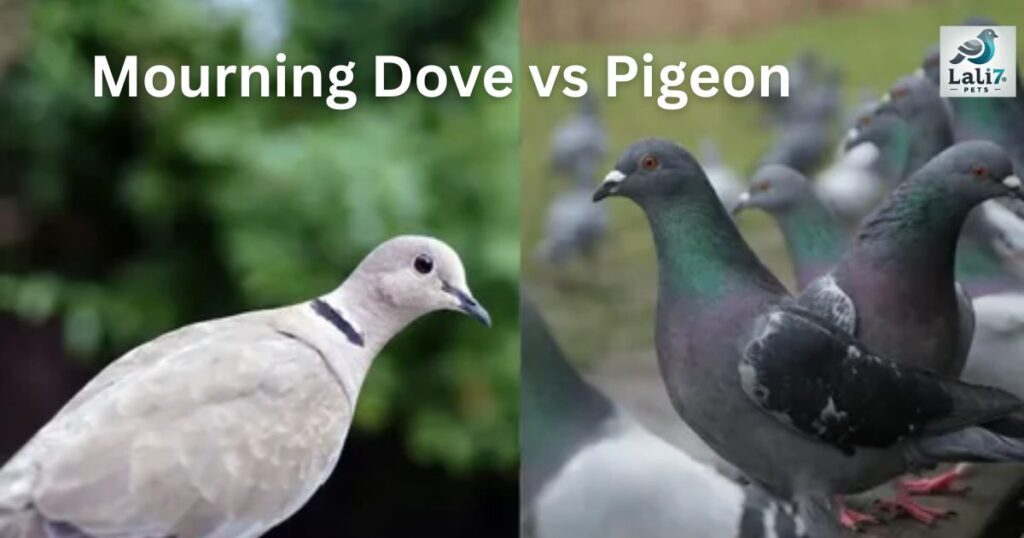
You are watching your bird feeder. A gray bird lands on the tray. It has a round head and a bobbing walk. Is it a symbol of peace or a city dweller looking for scraps? The confusion in the mourning dove vs pigeon debate is common because, scientifically, these birds are practically cousins.
However, once you look past the general silhouette, the differences are striking. From their tail shapes to their flight speeds, these two birds lead very different lives. Understanding these distinctions helps you attract the right visitors to your backyard and appreciate the diversity of the Columbidae family.
- The Scientific Reality: Are They the Same?
- Physical Appearance: The Identification Guide
- Comparison Table: Mourning Dove vs Pigeon
- Habitat and Range: Countryside vs. Concrete Jungle
- Behavior and Personality
- Diet and Feeding Habits
- Nesting Differences Mourning Dove vs Pigeon
- Cultural Symbolism: Peace vs. Pest
- FAQ: Common Questions About Mourning Dove vs Pigeon
The Scientific Reality: Are They the Same?
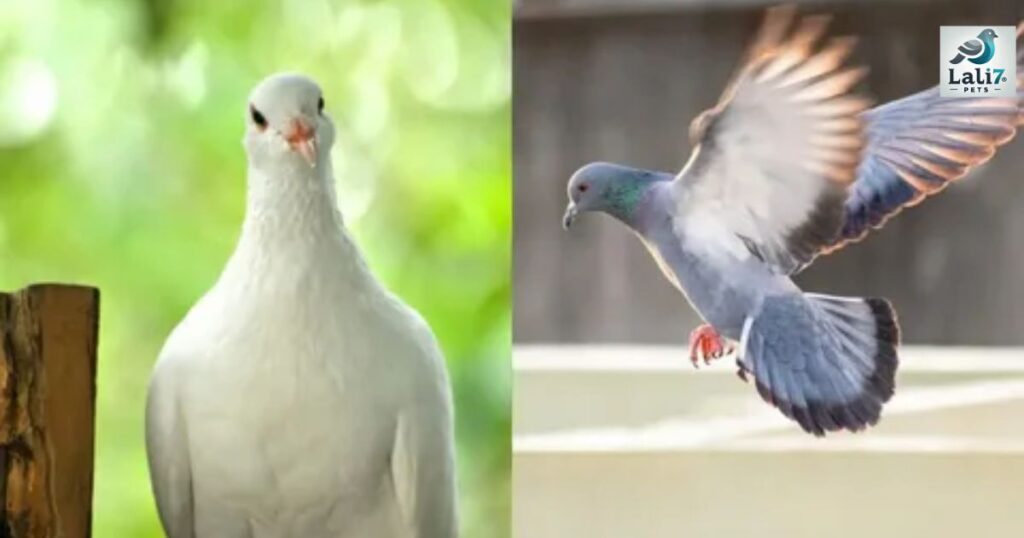
Before diving into physical differences, we must address the family tree. Both birds belong to the Columbidae family, which contains over 350 species worldwide.
The bird we commonly call a “pigeon” is scientifically the Columba livia, or Rock Pigeon. The bird we call a “mourning dove” is the Zenaida macroura.
According to betterwithbirds.com, the words “dove” and “pigeon” are often used interchangeably in science. However, in common English, we use “dove” to describe smaller, more delicate species, and “pigeon” for larger, stockier birds. While they share round heads, short necks, and short thin beaks, their lifestyles have diverged significantly over time.
Physical Appearance: The Identification Guide
Identifying these birds requires looking at three specific areas: the body shape, the tail, and the feather details.
Size and Silhouette
The Rock Pigeon is the linebacker of the bird world. They have stout bodies and a heavy-chested look. If you see a bird that looks like it is strutting with a puffed-out chest, it is likely a pigeon. They generally weigh between 9 and 13 ounces.
In contrast, the Mourning Dove is slender and elegant. They are smaller, weighing only 3 to 6 ounces. Their profile is smoother and less “chunky” than their city-dwelling cousins.
The Tail: The Dead Giveaway
If you only look at one feature, make it the tail.
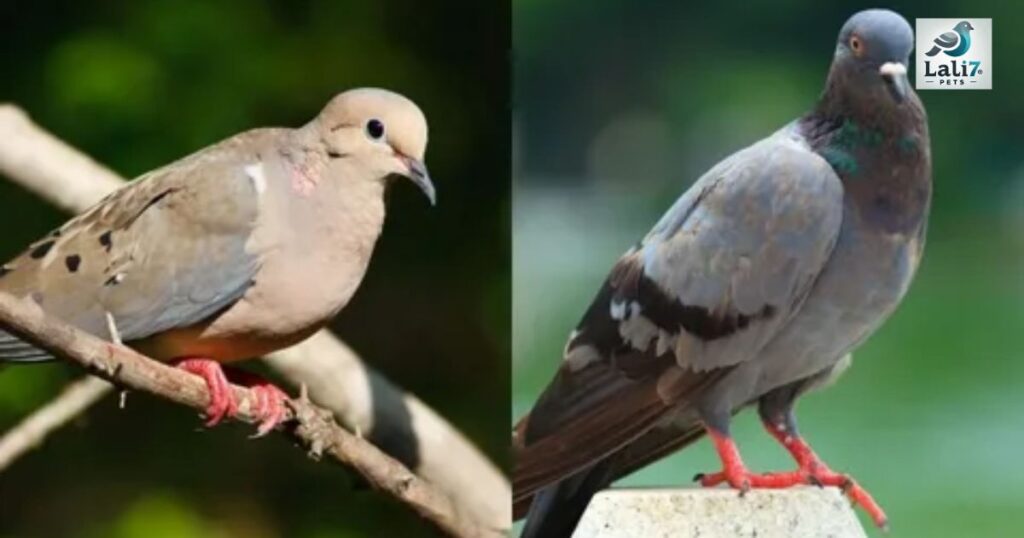
- Mourning Dove: They possess long, tapered tails. When they are perched, the tail looks pointed. In flight, you can clearly see white tips on the outer tail feathers.
- Rock Pigeon: They have fan-shaped tails that are shorter and broader. Even when folded, the tail looks blunt and rounded, not pointed.
Coloration and Markings
While both birds can appear gray from a distance, their markings are distinct.
- Mourning Dove: They are defined by a soft, tan coloration or brownish-gray hue. If you look closely at their wings, you will see distinct black spots on wings. A unique feature is the ring of pastel blue skin around eyes, which gives them a wide-eyed, gentle expression.
- Pigeon: Rock Pigeons are highly variable, but the wild type features a blue-gray head and neck. They are famous for the iridescent feathers on their neck that shimmer purple and green in the sunlight. Most wild pigeons also display two black bars across their wings.
Comparison Table: Mourning Dove vs Pigeon
For a quick reference on the specific data points regarding these birds, here is a comparison based on data from birdsandblooms and PetsCareWorld.
| Characteristic | Mourning Dove (Zenaida macroura) | Pigeon (Columba livia) |
|---|---|---|
| Size | 9–13 inches in length | 11–15 inches in length |
| Weight | 3–6 oz | 9–13 oz |
| Wingspan | 17–18 inches | 20–26 inches |
| Coloration | Pale grayish-brown with a hint of pink on the chest | Varied; gray, white, with an iridescent neck |
| Tail Shape | Long and pointed, with white edges | Rounded and bulkier |
| Eye Skin | Bare, blue skin around the eyes | Narrow band of skin, often vibrant |
| Sound | Soft, mournful cooing calls | Cooing sounds with variable tone and pitch |
| Behavior | Solitary or small family groups; monogamous | Social; large flocks; confident |
| Habitat | Open fields, gardens, woodland edges | Urban settings, rocky cliffs, cities |
| Nesting | Flimsy nests in trees or shrubs | Bulkier nests on ledges or rooftops |
| Flight Style | Fast and darting; whistling sound on takeoff | Strong, direct flight with rapid wingbeats |
| Diet | Seeds, grains, wild fruits | Seeds, grains, human food scraps |
| Personality | Shy, peaceful, introverted | Bold, extroverted, social |
Habitat and Range: Countryside vs. Concrete Jungle
Where you live often dictates which bird you see more often, though their ranges overlap significantly.
Mourning Doves are adaptable but prefer a touch of nature. You will find them in woodland edges, suburban gardens, prairies, and farmland. They are widespread across North America. While they will visit a city park, they generally avoid the deep “concrete canyons” of a major metropolis.
Rock Pigeons are the ultimate urban survivors. Their ancestors lived on rocky cliffs in Europe, North Africa, and Asia. To a pigeon, a skyscraper is just a tall cliff face. This is why they thrive in urban areas and nest on building ledges. They are comfortable in dense populations and are rarely found in deep forests or wilderness areas far from human structures.
Behavior and Personality
The personalities of these two birds are as different as their habitats.
Social Habits
If you see a massive group of 50 birds swarming a park bench, those are pigeons. Pigeons are incredibly social and feel safest in large flocks. They have a bold, confident nature and will walk right up to humans to beg for food.
Mourning Doves are the introverts of the bird world. They are typically monogamous and are usually seen in pairs or small family groups. They are shy and skittish; sudden movements will send them flying.
Flight Speed and Style
Do not let the pigeon’s waddle fool you—they are aerial athletes. Racing pigeons have been clocked at over 90 miles per hour. They are fast, strong flyers with deep, rapid wingbeats. Their flight path is usually direct.
Mourning Doves are also fast, reaching speeds of 55 mph, but their flight style is different. They fly with a erratic, darting motion. A key identifier is the sound: Mourning Doves make a distinctive wing-whistling sound immediately upon takeoff. This whistling is caused by the air rushing through their feathers and serves as an alarm signal to other birds.
Vocalizations
The soundscape of your backyard changes depending on the species. The low-pitched cooing calls of the Mourning Dove (“Hoo-a-hoo, hoo, hoo”) are often mistaken for owls. It is a soft, sorrowful sound.
Pigeons produce a throatier, deeper cooing (“Coo-roo-c’too-coo”). It is generally louder and more persistent, often heard echoing in train stations and city plazas.
Diet and Feeding Habits

Both species are granivorous, meaning they primarily eat seeds, but the pigeon has expanded its palate.
Step-by-Step: How to Feed Mourning Doves
If you want to attract Mourning Doves specifically, you need to offer the right menu in the right place.
- Select the Right Seed: Fill your feeders with millet, black oil sunflower seeds, nyjer, or cracked corn.
- Use Platform Feeders: Mourning Doves are ground feeders. They prefer tray feeders or scattering seed directly on the ground. They struggle to balance on small tube feeder perches.
- Keep it Quiet: Place the feeder in a quiet corner of the yard away from high traffic.
Pigeons, on the other hand, are opportunistic omnivores. While they love seeds and grains, they also consume human food, trash, and crumbs found on sidewalks. This dietary flexibility is a major reason for their success in urban areas.
Nesting Differences Mourning Dove vs Pigeon
If you find a nest in your yard, you can easily tell who built it by the construction quality.
Mourning Doves are notorious for building flimsy nests. They throw together a loose collection of pine needles and twigs, often in the fork of a tree or on a gutter. The nest is often so sparse that you can see the eggs from the bottom. Despite this, they are devoted parents.
Pigeons build bulkier nests. Staying true to their cliff-dwelling roots, they prefer flat surfaces like window ledges, bridge beams, and rooftops. They will reuse these locations repeatedly, adding more debris and droppings over time, which solidifies the nest structure.
Cultural Symbolism: Peace vs. Pest
Cultural perception is the final major difference in the mourning dove vs pigeon comparison.
Doves are universally viewed as symbols of peace, love, purity, and hope. They are released at weddings and featured in religious art. The Mourning Dove specifically is often seen as a spiritual messenger or a sign of comfort.
Pigeons, despite being the same family, suffer from a bad reputation. They are often dismissed as “rats with wings” due to their presence in dirty city environments and their messy droppings. However, this is unfair. Pigeons are intelligent, have incredible homing instincts, and have served humans as messengers during wars, saving countless lives.
FAQ: Common Questions About Mourning Dove vs Pigeon
Are Mourning Doves and Pigeons the Same Bird Species?
No, they are different species. While they are both in the Columbidae family, the Mourning Dove is Zenaida macroura and the Pigeon (Rock Dove) is Columba livia.
What’s the Main Difference Between Mourning Doves and Pigeons?
The most obvious difference is the tail. Mourning Doves have long, tapered tails with white tips, while pigeons have short, fan-shaped tails. Additionally, pigeons are larger and stockier.
Do Mourning Doves Have Any Symbolic Meanings?
Yes, they are frequently associated with peace, new beginnings, and a visitation from a lost loved one due to their mournful call.
What do mourning dove eggs look like?
Mourning dove eggs are small and pure white. They usually lay a clutch of two eggs.
Why is a dove called a dove and a pigeon called a pigeon?
The distinction is linguistic rather than scientific. “Dove” has Germanic roots and typically refers to smaller species, while “Pigeon” comes from French and refers to larger birds.
What sound does a mourning dove make vs a pigeon?
A Mourning Dove makes a soft, rhythmic “Hoo-a-hoo, hoo, hoo.” A pigeon makes a rolling, throatier coo that sounds like a strutting guttural noise.
Which bird is faster, a mourning dove or a pigeon?
The pigeon is faster. Rock Pigeons can reach speeds of 90 mph or more, whereas Mourning Doves top out around 55 mph.